
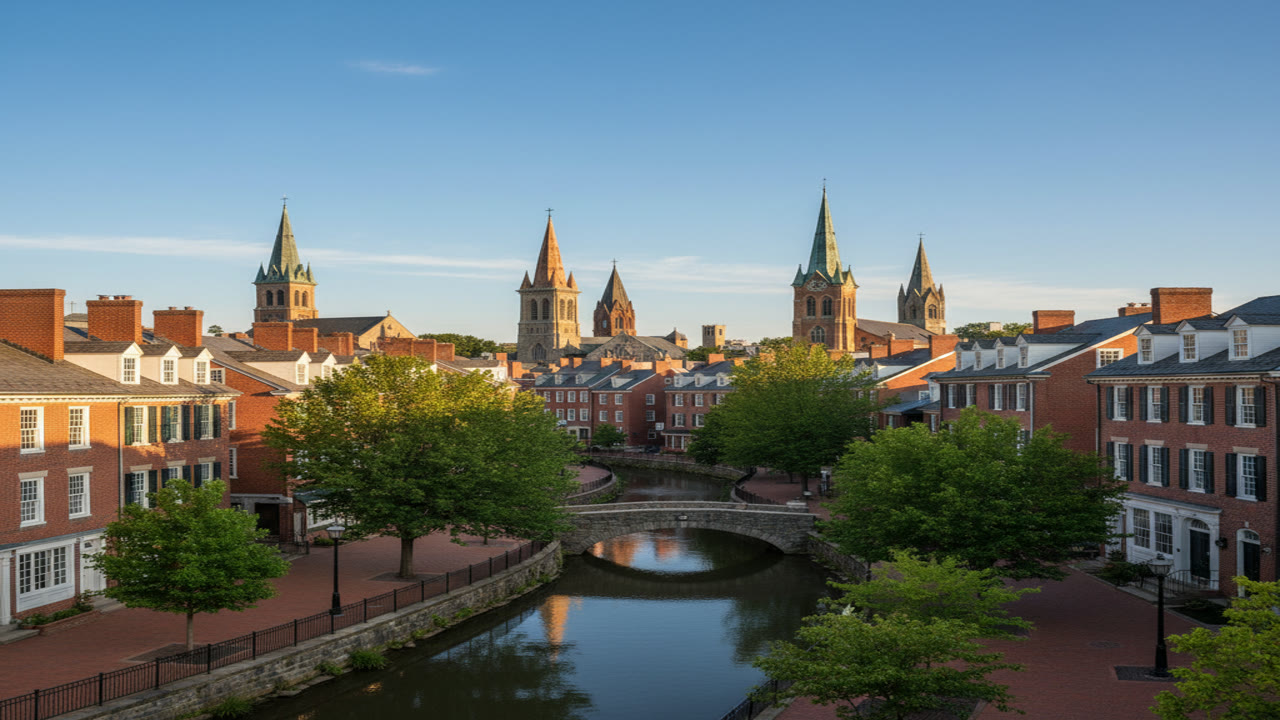
Frederick, Maryland historic downtown skyline with church spires and the Catoctin Mountains beyond
    Frederick, Maryland

    Pest Control Software Built for Frederick Operators

    Brick rowhomes packed tight in the historic district, working farmland along the Monocacy River, and the Golden Mile retail corridor give Frederick crews a route sheet that swings from cluster-fly attics to barn rodent jobs in the space of a few miles. Each of those Frederick calls is answered on the spot, not hours later.

    Typical Frederick implementation goes live in about 30-90 days.

    Why Frederick is a farm town and a commuter suburb at once

    Frederick sits where I-270 commuter growth meets Frederick County farmland, so a single day of calls can range from a downtown historic rowhome to a barn on the edge of the Monocacy Valley.

    Historic district rowhomes need careful, code-conscious treatment

    Shared-wall brick rowhomes near Carroll Creek and Market Street funnel German roaches and mice between units, and the historic preservation district limits exterior treatment options, so technicians need clear notes on what each property allows before they arrive.

    Monocacy Valley farms drive steady rodent and stored-product pest work

    Grain storage, dairy operations, and horse farms along the Monocacy River and Ballenger Creek keep barn and outbuilding rodent pressure constant, and those accounts often need scheduling that works around planting and harvest windows rather than a standard weekly route.

    The Golden Mile commercial corridor mixes retail, hospitality, and warehouse pests

    Route 40's strip centers, hotels, and light-industrial parks bring roach and rodent calls that need fast turnaround since a health-department complaint at a restaurant on the Golden Mile can threaten a permit.

    New Ballenger Creek and Urbana subdivisions bring first-year termite concerns

    Fast-growing subdivisions south of the city on former farmland sit on soil types new to many homeowners, and first-time buyers frequently call after seeing mud tubes or swarmers without knowing what they are looking at.

    What we build for you

    What that means for your phones and your crews

    We configure around a market where a downtown rowhome tenant and a Monocacy Valley farm manager need very different intake handling.

    Capture historic-district service restrictions before dispatch

    Voice AI logs property-specific notes, like exterior treatment limits in the historic district, so technicians show up prepared instead of discovering a restriction on-site.

    See Voice AI

    Schedule farm and outbuilding accounts around planting cycles

    The AI Sales System keeps commercial and agricultural account notes together, so scheduling around a farm's planting or harvest calendar does not depend on one office employee remembering it.

    See the AI Sales System

    Respond fast enough to protect Golden Mile restaurant accounts

    Messaging AI acknowledges commercial complaints immediately with a documented response time, which matters when a restaurant is racing a health inspection deadline.

    See Messaging AI

    Want to see what this looks like against your own Frederick call volume? We will walk through it on a 30-minute call.

    Book a Discovery Call

    Operators across the Frederick area

    Service areas across the city and into surrounding Frederick County are configured during onboarding.

    • Frederick
    • Ballenger Creek
    • Urbana
    • Walkersville
    • Middletown
    • New Market
    • Braddock Heights
    • Monrovia

    Connected to the software you already run

    We have a deep, purpose-built FieldRoutes integration, and over 1,000 API connections available for everything else, so your Frederick operation keeps one source of truth instead of four.

    All third-party product names, logos, and brands are property of their respective owners. Use of these names does not imply endorsement or affiliation.

    What AI adoption looks like in Frederick

    Frederick operators run routes that stretch from tight historic rowhomes to open farmland, and the office logistics for each look nothing alike. Consistent intake that captures property-specific details, whether that is a historic-district restriction or a farm's harvest schedule, keeps that variety from turning into missed appointments.

    • Historic district rowhomes have preservation rules that limit exterior treatment options
    • Monocacy Valley farms need scheduling built around planting and harvest windows
    • Golden Mile restaurants and hotels need fast response ahead of health inspections
    • New Urbana and Ballenger Creek subdivisions generate first-time termite questions

    Deciding whether AI is right for your business at all is a separate question from which market you are in. We answer it honestly, including when the answer is not yet, in our AI decision guides, starting with should I use AI in my pest control business.

    Frederick's pest calendar: rowhome pressure, farm cycles, and commercial-corridor demand

    Frederick's mix of tight historic housing, working farmland, and a busy retail strip means the pest calendar has to account for three very different property types at once.

    March - April

    As Monocacy Valley farms prepare fields, rodents displaced from winter cover start moving toward barns and outbuildings, while historic-district rowhomes near Carroll Creek see early-season German roach activity pick back up.

    May - June

    Termite swarmers emerge from foundations in Ballenger Creek and Urbana subdivisions built on former farmland, generating a wave of calls from first-time buyers unfamiliar with what a swarm looks like.

    July - August

    Heat and humidity push mosquito complaints up along the Monocacy River and Ballenger Creek, and Golden Mile restaurants deal with a seasonal rise in fruit flies and roach pressure tied to summer patio traffic.

    September

    Harvest season on Monocacy Valley farms displaces field mice toward barns and nearby homes, and stored-grain operations see stored-product pest calls rise as bins fill.

    October - November

    Cooling temperatures send rodents into historic-district rowhomes through shared walls and utility penetrations, and boxelder bugs and lady beetles stage on sun-facing brick throughout the older parts of the city.

    December - February

    Indoor rodent pressure holds steady all winter in both the rowhome core and newer Urbana construction, while Golden Mile commercial accounts keep to fixed inspection schedules regardless of the season.

    Running crews between rowhomes, farmland, and the Golden Mile

    Frederick's routes swing from shared-wall downtown blocks to open farmland to a busy retail strip, and each stretch has its own access and timing rules.

    US-15 and I-270 define the main commuter and commercial spine

    Most cross-town and commercial routes touch one of these two corridors, so scheduling avoids stacking Golden Mile and downtown stops during peak commute congestion.

    Historic district parking and access rules slow rowhome visits

    Narrow streets and limited parking near Carroll Creek and Market Street mean technicians sometimes need extra time to legally park before a scheduled rowhome visit.

    Monocacy Valley farm accounts require planting and harvest awareness

    Farm and outbuilding visits scheduled during active planting or harvest can conflict with equipment use, so those accounts typically need a call ahead to confirm timing rather than a fixed weekly slot.

    Golden Mile restaurants often want early-morning or after-close visits

    Retail and hospitality accounts along Route 40 frequently prefer service before opening or after closing to avoid disrupting customers during business hours.

    Urbana and Ballenger Creek subdivisions require frequent map updates

    New construction south of the city adds streets regularly, so routing software needs manual updates to keep newly built addresses from being dropped or mis-routed.

    Walkersville and Middletown add 15-25 minutes of drive time

    Both towns sit outside the city core, so those stops are typically grouped into a dedicated route block rather than mixed with in-town Frederick appointments.

    Winter road conditions vary sharply between farmland and city streets

    Open farm roads around the Monocacy Valley can stay icy longer than plowed city streets downtown, so winter routing sometimes prioritizes in-town stops earlier in the day.

    Frederick County health-department standards apply to Golden Mile accounts

    Restaurants along the Golden Mile operate under county health-inspection requirements, so pest service records for those accounts need to be complete and available on short notice.

    Frederick pest control questions we get asked

    Frederick AI guides

    Location-specific guides written for the pest pressure, routes, and customer behavior of this market.

    Frederick overview
    • Should you use AIShould I use AI in my Frederick pest control business?Coming soon.
    • Will customers talk to AIWill pest control customers in Frederick talk to AI?Coming soon.
    • Best AI for pest controlWhat is the best AI for pest control in Frederick?Coming soon.
    • Speed to leadHow can Frederick pest control companies win with speed-to-lead?Coming soon.
    • Best software stackWhat is the best pest control software for Frederick operators?Coming soon.
    • Local marketingHow should pest control companies in Frederick market themselves locally?Coming soon.
    • Reviews & reputationHow can Frederick pest control companies get more reviews and protect their reputation?Coming soon.
    • Seasonal playbookWhat is the seasonal pest control playbook for Frederick?Coming soon.
    • Commercial AIHow does AI help commercial pest control accounts in Frederick?Coming soon.
    • Hiring vs AIShould Frederick pest control operators hire office staff or use AI?Coming soon.
    Free 48 KB PDF

    Download the Frederick, MD Pest Control AI Playbook

    A short one-pager on the Frederick market, the systems we build for operators here, and how implementation runs, written to be printed and passed around.

    • A Frederick market snapshot, the pressure that drives your call volume
    • The AI systems we run for operators here, in plain language
    • What a 30-day implementation actually looks like
    • Printable, so you can hand it to your office team

    Last updated 2026-09-17

    Loading the Frederick playbook form

    Three ways to see it working in Frederick

    Book a demo

    A 30-minute walkthrough against your own Frederick call volume.

    Book a Discovery Call

    Start a chat

    Try the messaging AI that answers texts, webchat, and social for pest control teams.

    Start a Chat

    Start free with PestGPT

    Use our free pest control AI assistant today, no contract, no setup call.

    Try PestGPT Free
    Final step

    Let's look at your commercial response times

    Pull the last quarter of calls from Golden Mile restaurant and hotel accounts. We can show you how many were acknowledged within the hour and how many waited overnight.

    • A real review of your intake, not a canned demo
    • 30 minutes, and a typical implementation runs about 30-90 days
    • No contract to talk. We never share your details.

    Request your Frederick walkthrough

    Prefer to pick a time yourself? Book a Discovery Call