
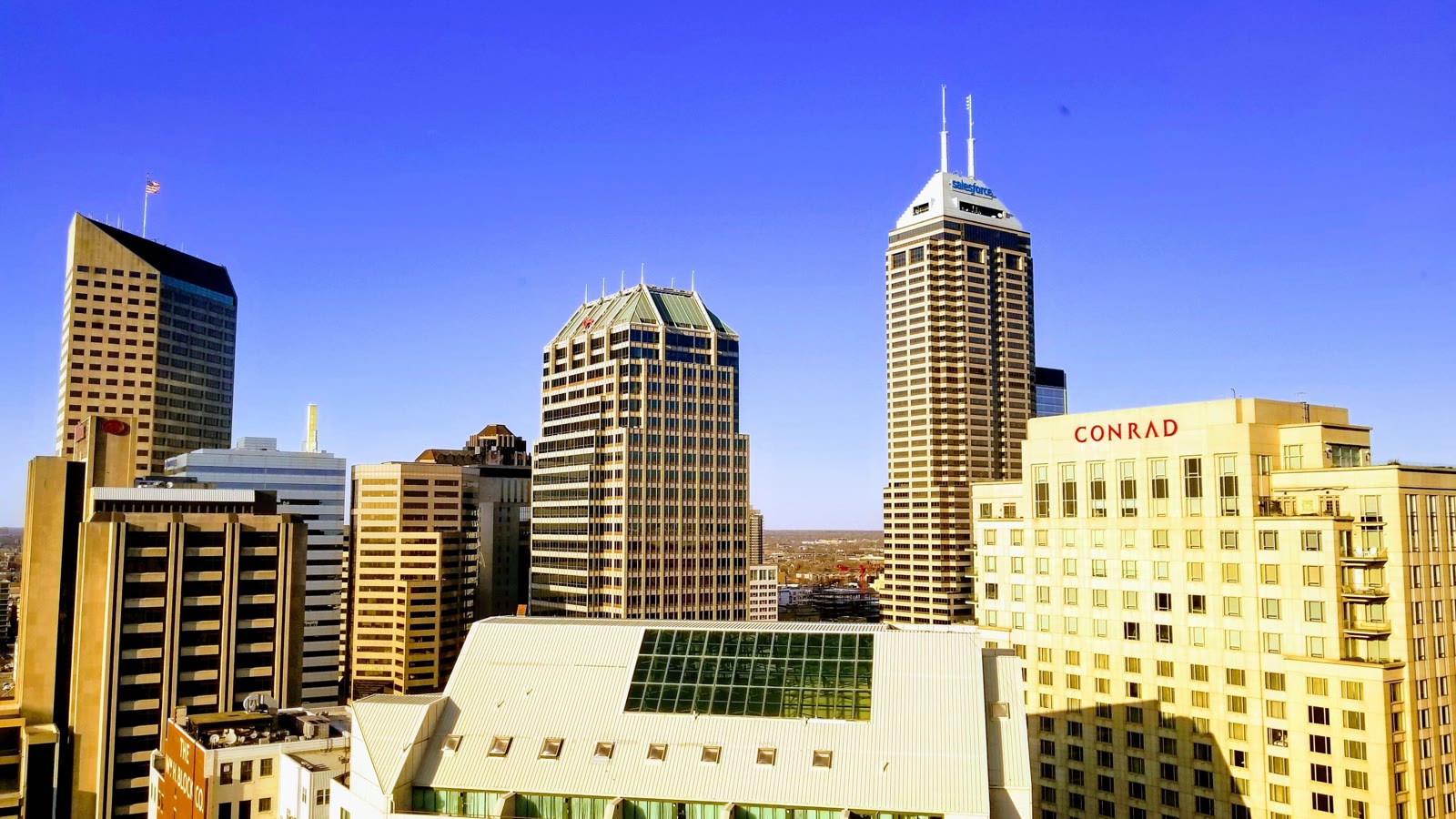
Downtown Indianapolis skyline towers including the Salesforce Tower under a clear blue sky
    Indianapolis, Indiana

    Pest Control Software Built for Indianapolis Operators

    Downtown high-rises around Monument Circle run on property-manager service agreements, older bungalow neighborhoods from Irvington to Broad Ripple have full basements that fill with mice every October, and Eagle Creek and Fort Harrison wooded parkland pushes wildlife into bordering subdivisions. Our AI systems answer every Indianapolis call the moment it comes in.

    Typical Indianapolis implementation goes live in about 30-90 days.

    Why Indianapolis pest demand splits between downtown towers and century-old bungalow blocks

    A state capital with a dense downtown office core, a ring of pre-1930s bungalow neighborhoods, and thousands of acres of city parkland produces call patterns that do not track a single seasonal curve.

    Downtown high-rise accounts around Monument Circle run on property-manager schedules

    Office towers and apartment high-rises along Meridian Street and the Mile Square are serviced under management-company contracts that expect scheduled visits and a documented log, so a missed confirmation reads very differently to a facilities manager than it does to a homeowner.

    Broad Ripple and Irvington bungalows fill with mice the week temperatures drop

    The 1920s and 1930s bungalow stock in Broad Ripple, Irvington, and Meridian-Kessler has full basements and older foundation seams, so the first hard frost in October produces a rodent-call spike concentrated in these neighborhoods rather than spread evenly across the metro.

    Eagle Creek Park and Fort Harrison push wildlife into bordering subdivisions

    Homes backing onto Eagle Creek Park on the northwest side and the wooded ravines around Fort Harrison State Park on the northeast see raccoon and squirrel attic complaints tied directly to that adjacent tree cover, a pattern distinct from the open-lot subdivisions further out on the interstate loop.

    The White River and Fall Creek floodplains produce moisture-pest surges after storms

    Low-lying stretches along the White River near the canal and along Fall Creek deal with basement dampness and camel cricket calls after heavy spring rain, timing that crews on higher ground in Carmel or Fishers do not see on the same schedule.

    Warehouse and logistics corridors along I-70 and I-465 sustain year-round rodent demand

    The dense concentration of distribution centers along I-70 east of downtown and the I-465 loop keeps commercial rodent contracts active in every season, since rail spurs and loading docks provide food and shelter regardless of outdoor temperature.

    What we build for you

    What that means for your phones and your crews

    We configure around a city where a downtown facilities manager and a Broad Ripple homeowner need entirely different handling on the same afternoon.

    Give downtown property-management accounts the documentation they expect

    Messaging AI timestamps every inspection confirmation and service note, giving high-rise facilities managers along Meridian Street the written log their management company requires for contract review.

    See Messaging AI

    Answer the Broad Ripple and Irvington rodent spike without adding staff

    Voice AI answers unlimited simultaneous calls at any hour, so the week the first hard frost hits and bungalow-neighborhood mouse calls surge, every caller reaches a live conversation instead of voicemail.

    See Voice AI

    Follow up on Eagle Creek-adjacent wildlife leads automatically

    The AI Sales System tracks address and complaint type from intake, so a raccoon or squirrel report near Eagle Creek Park or Fort Harrison routes into the right follow-up sequence instead of getting treated like a standard ant ticket.

    See Outbound Campaigns

    Want to see what this looks like against your own Indianapolis call volume? We will walk through it on a 30-minute call.

    Book a Discovery Call

    Operators across the Indianapolis metro

    Service areas from the Mile Square out to the northside neighborhoods and inner suburbs are configured during onboarding.

    • Broad Ripple
    • Irvington
    • Meridian-Kessler
    • Fountain Square
    • Speedway
    • Beech Grove
    • Lawrence
    • Southport

    Connected to the software you already run

    We have a deep, purpose-built FieldRoutes integration, and over 1,000 API connections available for everything else, so your Indianapolis operation keeps one source of truth instead of four.

    All third-party product names, logos, and brands are property of their respective owners. Use of these names does not imply endorsement or affiliation.

    What AI adoption looks like in Indianapolis

    Indianapolis operators split time between a downtown commercial base that expects documented, scheduled service and residential neighborhoods where century-old bungalow basements drive a sharp rodent spike every fall. A metro this size also means crews running from the Mile Square out past the interstate loop, so speed to first contact on a new lead matters as much as the service itself.

    • Downtown high-rise and office accounts expect timestamped inspection and service logs
    • Broad Ripple, Irvington, and Meridian-Kessler bungalow basements drive an October rodent spike
    • Eagle Creek Park and Fort Harrison State Park border neighborhoods with elevated wildlife pressure
    • White River and Fall Creek floodplain blocks see moisture-pest calls after heavy spring rain

    Deciding whether AI is right for your business at all is a separate question from which market you are in. We answer it honestly, including when the answer is not yet, in our AI decision guides, starting with should I use AI in my pest control business.

    The Indianapolis pest calendar, quarter by quarter

    Central Indiana's humid continental climate, mixed housing ages, and dense downtown core produce a pest calendar with sharp neighborhood-specific peaks rather than one citywide curve.

    March - May

    Spring rain along the White River canal and Fall Creek floodplain drives camel cricket and moisture-pest calls in low-lying basements well before drier, higher-ground neighborhoods like Speedway or Southport see similar activity. Carpenter ants become active in older Meridian-Kessler and Irvington homes as soil warms, and downtown high-rise accounts begin their spring inspection cycle as management companies prepare properties for warmer weather.

    June - August

    Wasp and hornet activity peaks across the metro as colonies reach full size, with older neighborhoods featuring mature tree cover, like Broad Ripple and Irvington, generating more nest-removal calls than newer subdivisions with less canopy. Warehouse and logistics accounts along I-70 and I-465 maintain steady rodent-prevention service through summer regardless of season, since dock activity and shipment volume, not weather, drive their pest pressure.

    September - October

    The first hard frost, typically arriving in mid-to-late October, triggers the year's sharpest event: a surge of mouse and rodent calls concentrated in the 1920s and 1930s bungalow basements of Broad Ripple, Irvington, and Meridian-Kessler, where older foundation seams give rodents easy access as they seek warmth. Eagle Creek Park and Fort Harrison-adjacent homes see a parallel rise in raccoon and squirrel activity as wildlife seeks denning sites ahead of winter.

    November - February

    Rodent calls remain the dominant category through winter as mice that gained entry during the fall surge continue reproducing indoors, and downtown high-rise accounts shift toward interior monitoring and documentation rather than exterior treatment. Commercial logistics accounts along the interstate loop see their most consistent volume of the year, since heated warehouse space becomes an even more attractive rodent destination once outdoor temperatures drop.

    Early summer: termite swarm season across the pre-1950s housing ring

    Warming soil in May and June triggers subterranean termite swarms across Indianapolis's ring of pre-1950s neighborhoods, including Irvington, Fountain Square, and Meridian-Kessler, where mature trees and older foundations create conditions termites favor. Newer subdivisions in Southport and parts of Lawrence see comparatively few swarms by contrast, since younger construction and less established landscaping offer fewer entry points.

    Late summer: mosquito pressure along Fall Creek and the White River greenway

    Standing water along the Fall Creek and White River greenway trails, especially after heavy July and August storms, sustains elevated mosquito activity through late summer in neighborhoods bordering these waterways. Homeowners near the canal and Fall Creek corridor request backyard mosquito treatment ahead of outdoor events at a noticeably higher rate than residents in drier, higher-elevation parts of the city like Speedway.

    What routing the Indianapolis metro actually costs you

    Indianapolis's combination of a dense downtown core, the I-465 interstate loop, and a wide ring of inner suburbs means route efficiency depends heavily on grouping stops by neighborhood age and account type.

    The I-465 loop and downtown one-way grid demand different routing logic

    Crews serving downtown high-rise accounts navigate the Mile Square's one-way streets and limited parking, while suburban stops toward Speedway or Southport run efficiently off the I-465 loop, and a single day mixing both without planning the transition wastes real time in downtown traffic.

    Downtown high-rise stops require building access coordination

    Office towers and apartment high-rises around Monument Circle require check-in with building security or a property manager before a technician can reach the service area, adding a fixed block of time to every downtown stop that a residential Broad Ripple visit does not carry.

    Bungalow-neighborhood rodent jobs need longer basement-focused visits

    The full basements and older foundation seams common in Broad Ripple, Irvington, and Meridian-Kessler homes mean fall rodent exclusion jobs take longer than a standard visit, and scheduling them with a standard time slot during the October surge understaffs the day.

    Eagle Creek and Fort Harrison wildlife calls need specialized equipment on the truck

    Raccoon and squirrel exclusion work near Eagle Creek Park and Fort Harrison State Park requires trap and exclusion equipment that a standard ant-and-roach route does not carry, so grouping these calls into a dedicated wildlife-response day is more efficient than treating each as an ad hoc stop.

    I-70 and I-465 logistics-corridor commercial accounts run on fixed inspection schedules

    Warehouse and distribution-center accounts along the interstate loop operate under contracts with fixed, recurring inspection dates, and these stops carry documentation requirements that add time per visit compared with a routine residential call.

    White River and Fall Creek floodplain stops spike unpredictably after storms

    Camel cricket and moisture-pest calls from low-lying blocks near the canal and Fall Creek arrive in clusters immediately after heavy rain, and a route with no flexibility to absorb a same-week surge from these neighborhoods loses time double-booking or rescheduling later in the week.

    Outer suburbs like Southport and Lawrence carry longer drive times per stop

    Homes in Southport and Lawrence sit farther from the urban core than Broad Ripple or Fountain Square, and routes serving these areas benefit from batching stops geographically rather than mixing them with downtown or near-eastside jobs on the same day.

    Fountain Square's mixed commercial-residential blocks need flexible time windows

    The dense mix of restaurants, retail, and older residential buildings in Fountain Square means back-to-back stops can shift between commercial documentation needs and residential scheduling within the same block, and crews benefit from confirming which type of stop is next before arriving.

    Indianapolis pest control questions we get asked

    Indianapolis AI guides

    Location-specific guides written for the pest pressure, routes, and customer behavior of this market.

    Indianapolis overview
    • Should you use AIShould I use AI in my Indianapolis pest control business?Coming soon.
    • Will customers talk to AIWill pest control customers in Indianapolis talk to AI?Coming soon.
    • Best AI for pest controlWhat is the best AI for pest control in Indianapolis?Coming soon.
    • Speed to leadHow can Indianapolis pest control companies win with speed-to-lead?Coming soon.
    • Best software stackWhat is the best pest control software for Indianapolis operators?Coming soon.
    • Local marketingHow should pest control companies in Indianapolis market themselves locally?Coming soon.
    • Reviews & reputationHow can Indianapolis pest control companies get more reviews and protect their reputation?Coming soon.
    • Seasonal playbookWhat is the seasonal pest control playbook for Indianapolis?Coming soon.
    • Commercial AIHow does AI help commercial pest control accounts in Indianapolis?Coming soon.
    • Hiring vs AIShould Indianapolis pest control operators hire office staff or use AI?Coming soon.
    Free 49 KB PDF

    Download the Indianapolis, IN Pest Control AI Playbook

    A short one-pager on the Indianapolis market, the systems we build for operators here, and how implementation runs, written to be printed and passed around.

    • A Indianapolis market snapshot, the pressure that drives your call volume
    • The AI systems we run for operators here, in plain language
    • What a 30-day implementation actually looks like
    • Printable, so you can hand it to your office team

    Last updated 2026-09-17

    Loading the Indianapolis playbook form

    Three ways to see it working in Indianapolis

    Book a demo

    A 30-minute walkthrough against your own Indianapolis call volume.

    Book a Discovery Call

    Start a chat

    Try the messaging AI that answers texts, webchat, and social for pest control teams.

    Start a Chat

    Start free with PestGPT

    Use our free pest control AI assistant today, no contract, no setup call.

    Try PestGPT Free
    Final step

    Let's look at your Indianapolis call numbers

    Bring your call volume from the first cold week of last October and your downtown account list. We can show you how many calls went to voicemail and what a documented log would have looked like.

    • A real review of your intake, not a canned demo
    • 30 minutes, and a typical implementation runs about 30-90 days
    • No contract to talk. We never share your details.

    Request your Indianapolis walkthrough

    Prefer to pick a time yourself? Book a Discovery Call