
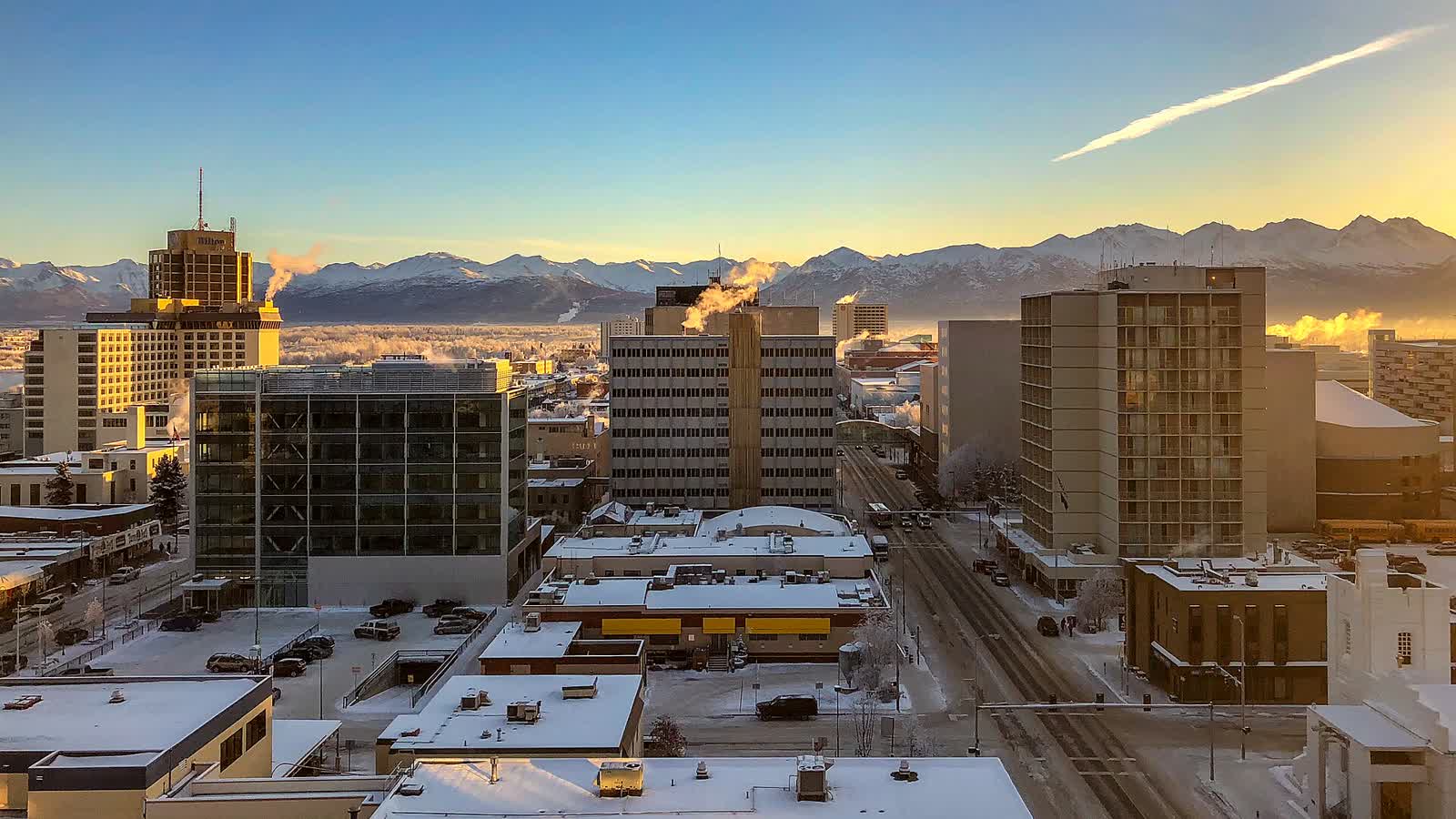
Downtown Anchorage, Alaska skyline with the Chugach Mountains behind it
    Anchorage, Alaska

    Pest Control Software Built for Anchorage Operators

    Twenty hours of summer daylight that sets off an explosive wasp and yellowjacket season, voles and shrews pushing into crawl spaces once the Chugach foothills freeze, and a service area that stretches from Eagle River to the Kenai spur without much daylight to work with in January. Our AI systems keep answering the phone through every part of that cycle.

    Typical Anchorage implementation goes live in about 30-90 days.

    Why Anchorage pest work runs on daylight, not the calendar

    A subarctic climate with nearly opposite daylight extremes drives call patterns that do not resemble any Lower 48 market.

    Summer's nearly endless daylight triggers an explosive wasp season

    From June through August, paper wasps and yellowjackets build nests aggressively in eaves and woodpiles across neighborhoods like Turnagain and South Addition, and homeowners start calling the moment they spot the first nest near a deck.

    Voles and shrews push indoors as the ground freezes

    Once temperatures drop in October, small rodents move out of the tundra and birch stands ringing the Anchorage bowl and into crawl spaces and garages, generating a steady exclusion workload that runs through the dark months.

    The Seward Highway commute limits how many stops a truck can make in daylight

    Techs routing between Anchorage, Girdwood, and the Kenai spur lose usable daylight fast in winter, so dispatch has to be tight or a truck burns half a route just driving between appointments.

    Military and shift-work households need scheduling outside normal business hours

    With Joint Base Elmendorf-Richardson nearby and a large share of residents working rotating shifts tied to oil, air cargo, and fishing seasons, a lot of Anchorage homeowners can only take calls or texts outside the standard nine-to-five.

    Carpenter ants work moisture-damaged wood in older Spenard homes

    Older housing stock in Spenard and Fairview, much of it built decades before current moisture codes, gives carpenter ants soft, damp framing to tunnel through near bathrooms and roof valleys, producing a slow but steady stream of structural inspection calls that peaks in late summer.

    Ted Stevens cargo hub traffic brings occasional stored-product pests to warehouses

    Anchorage handles a disproportionate share of air cargo passing between Asia and the Lower 48, and the warehouses and freight forwarders clustered near Ted Stevens International need pantry-pest and stored-product inspections tied to shipment schedules rather than a standard weekly route.

    What we build for you

    What that means for your phones and your crews

    We build around a market where daylight, not weather in the usual sense, dictates when your crews can work and when your phones ring.

    Handle the June wasp-call spike without hiring seasonal staff

    Voice AI answers every call the moment yellowjacket activity picks up across the Anchorage bowl, capturing nest locations and urgency so your crew's route stays efficient during the shortest window of the year to work outdoors.

    See Voice AI

    Text shift workers on their schedule, not yours

    Messaging AI lets JBER families and fishing- or oil-industry households confirm rodent exclusion appointments whenever they are actually awake, instead of losing them to a missed nine-to-five callback.

    See Messaging AI

    Book fall exclusion work before the ground freezes

    The AI Sales System follows up with homeowners who called about a single vole sighting last winter, converting them into sealed-and-protected exclusion contracts before the next freeze.

    See the AI Sales System

    Want to see what this looks like against your own Anchorage call volume? We will walk through it on a 30-minute call.

    Book a Discovery Call

    Operators across the Anchorage bowl and beyond

    Service areas from the Anchorage bowl out to Eagle River and the Mat-Su are configured during onboarding.

    • Anchorage
    • Eagle River
    • Girdwood
    • Chugiak
    • Wasilla
    • Palmer

    Connected to the software you already run

    We have a deep, purpose-built FieldRoutes integration, and over 1,000 API connections available for everything else, so your Anchorage operation keeps one source of truth instead of four.

    All third-party product names, logos, and brands are property of their respective owners. Use of these names does not imply endorsement or affiliation.

    What AI adoption looks like in Anchorage

    Anchorage operators work against a daylight clock more than a seasonal one, with nearly 20 hours of summer sun compressing a wasp season into a few frantic weeks and winter darkness limiting how many stops a truck can safely make. AI systems that answer instantly and route intelligently matter more here than in markets where weather, not daylight, sets the pace.

    • Nearly 20 hours of summer daylight compresses wasp season into a short, intense window
    • Voles and shrews push into crawl spaces once the Chugach foothills freeze in fall
    • Winter daylight limits how many stops a truck can make between Anchorage and Girdwood
    • JBER and shift-work households need scheduling outside standard business hours

    Deciding whether AI is right for your business at all is a separate question from which market you are in. We answer it honestly, including when the answer is not yet, in our AI decision guides, starting with should I use AI in my pest control business.

    Anchorage's pest calendar: daylight extremes drive everything

    Anchorage runs on two opposite daylight extremes rather than four distinct seasons, and that daylight swing, more than temperature alone, decides which pests are active and how many hours a crew has to reach them.

    April - May

    As snowpack melts off the Anchorage bowl and daylight lengthens fast, overwintered rodents that spent the dark months in crawl spaces start showing renewed activity, and the first wasp queens emerge to scout nest sites in eaves along Turnagain and Rogers Park before the real surge begins.

    June - August

    Nearly round-the-clock daylight fuels an explosive paper wasp and yellowjacket season across the bowl, with nests appearing fast in woodpiles, decks, and eaves. This same stretch brings peak tourist and cruise traffic through downtown and the coastal trail, adding commercial pest calls from restaurants and hotels working at full capacity.

    September - October

    As daylight collapses back toward winter levels, voles and shrews start abandoning tundra and birch stands ringing the bowl for crawl spaces, garages, and shed foundations, and carpenter ant activity in older Spenard and Fairview homes tends to peak as moisture from fall rain works into damaged framing.

    November - January

    Deep winter darkness pushes almost all pest activity indoors and compresses the usable daylight window for outdoor exclusion work to just a few hours around midday. Crews prioritize interior rodent work and defer siding or roofline sealing jobs until daylight returns unless a homeowner has an active, urgent infestation.

    February - March

    Daylight starts stretching out again, and homes near Joint Base Elmendorf-Richardson and along the Glenn Highway corridor begin reporting mice that spent the darkest months undetected in insulation and wall voids, discovered only once residents start doing spring-adjacent cleaning.

    Cargo and shipment cycles year-round

    Independent of season, warehouses and freight forwarders near Ted Stevens International need stored-product pest inspections timed to inbound cargo schedules rather than the calendar, since a single contaminated pallet can trigger an urgent same-day inspection request at any time of year.

    Running crews across the Anchorage bowl and the Seward Highway corridor

    Anchorage's service area covers a dense urban bowl, military installations with their own access rules, and a long stretch of highway running south toward Girdwood, and daylight availability changes how routes get built more than distance does.

    Winter daylight compresses the Seward Highway route to Girdwood

    The drive from downtown Anchorage to Girdwood along the Seward Highway takes about 45 minutes each way, and in December that route eats a large share of the roughly five and a half hours of usable daylight, so dispatch groups Girdwood and Turnagain Arm stops into a single trip rather than sending a truck back and forth.

    JBER access requires cleared appointment windows

    Technicians working on Joint Base Elmendorf-Richardson housing or facilities need ID verification and scheduled access windows arranged in advance, so those jobs typically get booked with more lead time than an off-base residential call.

    The Glenn Highway carries Eagle River and Chugiak traffic into the bowl

    Crews serving Eagle River and Chugiak commute the Glenn Highway alongside a heavy flow of daily commuters, so routing avoids scheduling those legs during the morning and evening rush when the corridor slows significantly.

    Summer construction season narrows road capacity citywide

    Alaska's short building season means road and utility construction is compressed into the same summer months when wasp calls peak, and lane closures on arterials like the Seward Highway or Northern Lights Boulevard can add unpredictable delays to same-day dispatch.

    Ice and snow removal schedules affect residential access in winter

    Neighborhoods on the hillside above Anchorage, like those near Upper Hillside and O’Malley, can have steep, icy driveways that slow technician access after a snowfall, so winter routing sometimes leaves those stops for later in the day once plows and sanding trucks have passed.

    Commercial cargo and hospitality accounts run on their own clocks

    Downtown hotels and restaurants serving the summer cruise and tourism trade need pest service scheduled around guest turnover and kitchen hours, while cargo warehouses near Ted Stevens International need inspections aligned with shipment arrivals, so both groups typically sit on separate route blocks from standard residential service.

    Anchorage pest control questions we get asked

    Anchorage AI guides

    Location-specific guides written for the pest pressure, routes, and customer behavior of this market.

    Anchorage overview
    Free 48 KB PDF

    Download the Anchorage, AK Pest Control AI Playbook

    A short one-pager on the Anchorage market, the systems we build for operators here, and how implementation runs, written to be printed and passed around.

    • A Anchorage market snapshot, the pressure that drives your call volume
    • The AI systems we run for operators here, in plain language
    • What a 30-day implementation actually looks like
    • Printable, so you can hand it to your office team

    Last updated 2026-09-17

    Loading the Anchorage playbook form

    Three ways to see it working in Anchorage

    Book a demo

    A 30-minute walkthrough against your own Anchorage call volume.

    Book a Discovery Call

    Start a chat

    Try the messaging AI that answers texts, webchat, and social for pest control teams.

    Start a Chat

    Start free with PestGPT

    Use our free pest control AI assistant today, no contract, no setup call.

    Try PestGPT Free
    Final step

    Let's look at your summer call log

    Pull your numbers from last June and July. We'll show you how many wasp calls came in during Anchorage's longest daylight stretch and how many turned into booked visits.

    • A real review of your intake, not a canned demo
    • 30 minutes, and a typical implementation runs about 30-90 days
    • No contract to talk. We never share your details.

    Request your Anchorage walkthrough

    Prefer to pick a time yourself? Book a Discovery Call