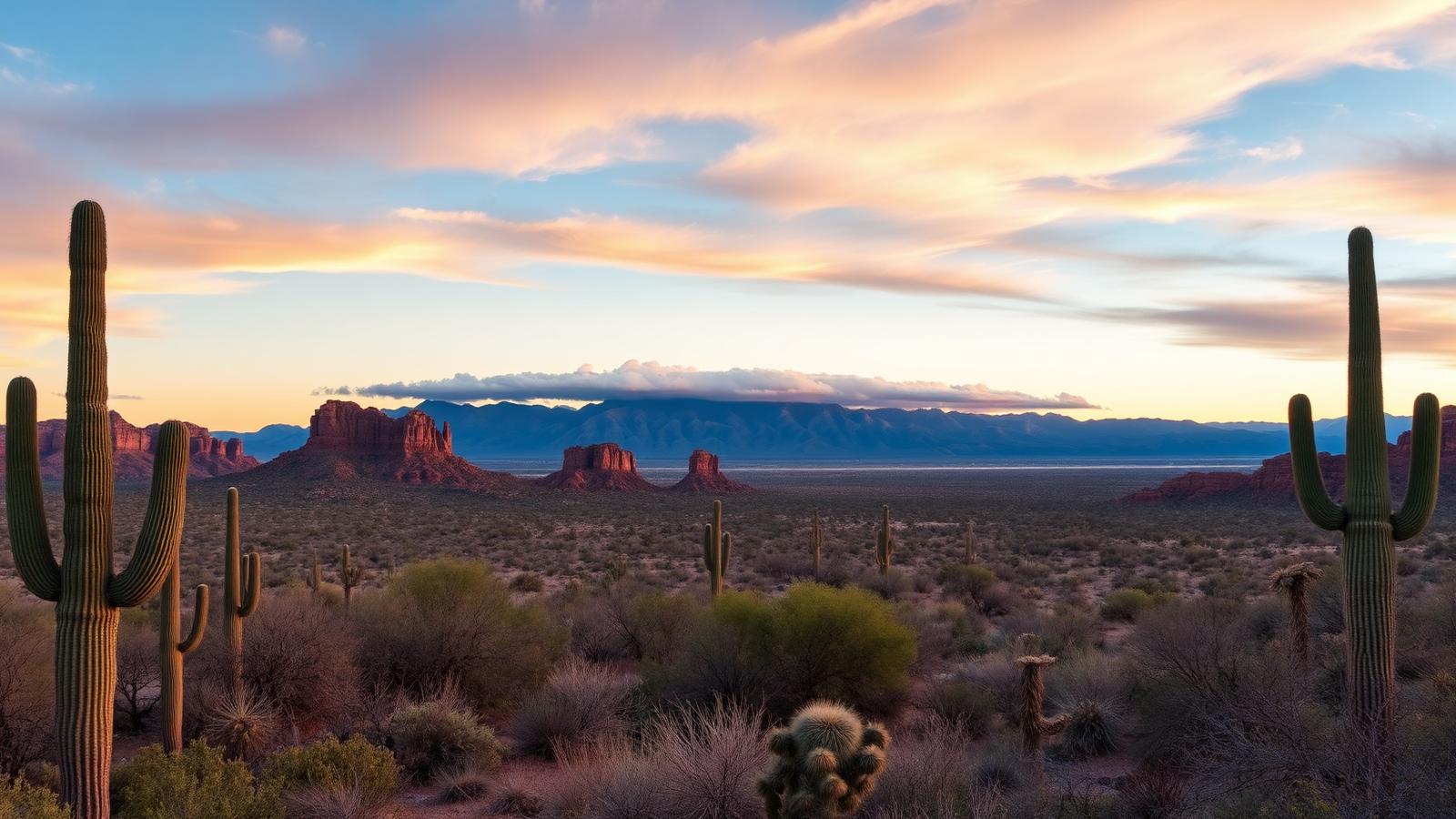
Year-round service, a monsoon that rewrites the schedule overnight, and a Valley you can drive for ninety minutes without leaving. We build the phone, messaging, and CRM layer that keeps Arizona trucks full in every season.
Typical Arizona implementation goes live in about 30-90 days.
Calls answered and booked
24/7Calls answered and booked
Software integrations available
1,000+Software integrations available
Bilingual intake by default
EN + ESBilingual intake by default
Typical time to live
30-90 daysTypical time to live
Most Arizona pest control revenue sits in the Valley of the Sun: Phoenix, Mesa, Chandler, Gilbert, Scottsdale, Glendale, Peoria, Tempe, Surprise, and the newer growth out toward Buckeye, Queen Creek, and Maricopa, with Tucson and the Old Pueblo suburbs of Oro Valley, Marana, and Vail forming the second major market. Beyond those, Prescott and the Quad Cities, Flagstaff and the high country, Lake Havasu and the river communities, Yuma’s agricultural corridor, and Sierra Vista in the southeast each carry different pressure. A pine-country operation in Flagstaff and a low-desert operation in Chandler barely share a pest list, so we configure intake, pricing, and campaign timing per market rather than shipping one statewide script.
What makes an Arizona operation different
The desert removes the off-season most of the country plans around, then concentrates the worst of the year into monsoon. What separates operators here is capacity when the phone spikes and follow-up when it does not.
Bark scorpions make service urgent, not optional
The Arizona bark scorpion is the reason a large share of Valley households buy recurring service at all. A sting in a house with small children turns into a call that will be answered by whoever picks up first, and that caller is buying a program, not a one-time spray.
Monsoon rewrites the schedule for six weeks
From July into September, storms drive scorpions, roaches, crickets, and rodents into structures and flood the phones with same-day requests. The office that can absorb three times normal call volume without a hold queue takes market share every single year.
There is no winter shutdown to plan around
Low-desert pressure never fully stops, so recurring programs run twelve months and the real risk is churn rather than seasonality. Retention, re-service handling, and payment recovery matter more here than in a market that hibernates from November to March.
Snowbirds double the address book half the year
Winter residents arrive in the fall and leave in the spring, which means vacant-home service, seasonal restarts, and a hard annual window to reactivate accounts. Companies that let those customers lapse each summer are rebuying the same household every year.
Valley sprawl is a routing problem, not a map
Surprise to Queen Creek is an hour and a half in good traffic. Booking that ignores geography does not just lose a stop, in a metro this wide it can cost most of an afternoon.
Africanized bees are a same-day safety call
Colonies established across southern Arizona make swarm and hive calls a public safety issue rather than a nuisance job. Those calls need immediate qualification, correct routing to a licensed tech, and a real time window on the first contact.
The systems we build around an Arizona operation
We are an implementation partner, not another dashboard for your CSRs to learn. Here is what gets built, and why each piece pays in the desert.
Monsoon-night calls all answered at once
When the first big storm sends scorpion and roach calls in after 9pm, Voice AI answers every simultaneous call, qualifies the property, quotes from your price book, and books into the nearest open route, in English or Spanish.
Messaging AI runs SMS, email, webchat, and social in one thread, reaching seasonal residents before they fly back so the service restart is booked ahead of the first call rather than after the first sighting.
The AI Sales System holds every quote, program, and lapsed account in one pipeline with automated follow-up, review requests, failed-payment recovery, and reactivation campaigns aimed at customers who cancelled last summer.
PestMail reads your route data and mails the neighbors around every stop, which across a metro as spread out as the Valley means new customers that fit between existing ones instead of another cross-town drive.
What is the best pest control setup for scorpion calls in Arizona?
Arizona scorpion calls should convert to a recurring exterior program with sealing recommendations rather than a one-time treatment, because bark scorpions re-enter from block walls, irrigation, and neighboring yards continuously and a single spray does not hold. Intake needs to capture whether anyone has been stung, whether there are small children or pets, and where sightings occur, since a sting call is an urgent scheduling priority and converts to an annual program far more often.
Flag any sting in the household as priority same-day scheduling.
Quote the recurring program on the first call, not a one-time spray.
Capture sighting locations so the tech targets entry points and block walls.
Monsoon surges
How should Arizona pest control companies handle monsoon season call volume?
Monsoon call volume in Arizona is best handled with unlimited-capacity answering and pre-reserved same-day slots, because a single July storm can triple inbound calls overnight and every one of those callers is shopping on who can come out first. The systems should book straight into held emergency capacity, text an immediate confirmation, and drop overflow into a next-morning queue rather than voicemail.
Reserve daily same-day capacity through July, August, and September.
Never send storm-night callers to voicemail, answer and book or queue.
Trigger a post-storm campaign to the surrounding neighborhood.
Africanized honey bees
What is the best response for bee swarm and hive calls in Arizona?
Bee swarm and established-hive calls in Arizona should be handled as same-day safety escalations with immediate human routing, because Africanized colonies are widespread across the southern part of the state and a hive in a wall void or utility box is a genuine hazard. Intake must capture the location, whether the colony is a swarm cluster or an established hive in a structure, and whether anyone has been stung, then route to a licensed tech rather than a standard booking queue.
Escalate any sting or school, daycare, or public-space location immediately.
Distinguish a temporary swarm cluster from an established structural hive.
Give a firm same-day window; these callers do not wait.
Roaches
What is the best pest control program for roaches in Arizona?
Arizona roach calls should be split at intake between German cockroaches inside a kitchen or apartment and American and Turkestan roaches entering from irrigation, sewers, and landscape, because one is a multi-visit interior baiting program with prep requirements and the other is a perimeter, drain, and exclusion job. Irrigation cycles and monsoon moisture keep exterior pressure high, so recurring service converts much better than one-time treatment.
Qualify indoor versus outdoor sightings and unit count before quoting.
Send bilingual prep instructions by text before interior treatments.
Ask about irrigation schedules and drains, they are the usual source.
Desert subterranean termites
What is the best pest control setup for termite calls in Arizona?
Arizona termite calls should be booked as inspections rather than quoted over the phone, because desert subterranean termites build mud tubes on block walls, slabs, and foundations and the treatment scope depends entirely on construction and soil conditions. Intake should capture whether the caller is seeing mud tubes, damaged wood, or swarmers after a rain, plus whether a real estate transaction is driving the timeline.
Ask whether a closing or lender deadline is involved and prioritize it.
Capture mud tube locations and construction type before dispatch.
Expect a swarm bump after monsoon rains, not only in spring.
Rodents & pack rats
What is the best pest control setup for rodent and pack rat calls in Arizona?
Rodent work in Arizona should be sold inspection-first with exclusion and vehicle-risk screening attached, because roof rats in the Phoenix citrus corridor and pack rats across desert foothill properties both cause damage that trapping alone will not stop. Intake should capture where noise is heard, whether there is attic access, whether a vehicle or equipment has been chewed, and whether the property backs to a wash or open desert.
Ask about attic access and any vehicle wiring damage at intake.
Quote exclusion and trapping as one program with a defensible guarantee.
Flag properties backing to washes or open desert for pack rat protocols.
Snowbird & seasonal homes
What is the best pest control setup for snowbird and seasonal properties in Arizona?
Seasonal Arizona homes are best served with an annual program that includes vacant-period exterior service and an automatic restart before the owner returns, because a house closed up from May to October accumulates scorpion, roach, and rodent pressure with nobody there to report it. The systems should track arrival and departure months per customer and run the reactivation outreach on that calendar rather than a generic renewal date.
Store each seasonal customer’s arrival and departure months.
Sell reduced-frequency exterior service for the vacant period.
Run reactivation outreach weeks before they fly back, not after.
Bed bugs
What is the best pest control intake setup for bed bug calls in Arizona?
Bed bug leads need discreet same-day qualification of room count, confirmed evidence, and property type before any number is discussed, because a single Gilbert bedroom and a Scottsdale resort floor are entirely different jobs. With heavy spring training, resort, and university traffic, hospitality and short-term-rental calls should escalate to a human immediately rather than sitting in a booking queue.
Qualify room count and confirmed evidence before quoting a range.
Escalate hotel, resort, and short-term-rental calls to a human.
Identify the paying party on rental-property calls before dispatch.
Commercial & food service
What is the best pest control setup for restaurants and commercial accounts in Arizona?
Arizona commercial accounts are best protected with documented recurring service and instant escalation handling, because Maricopa and Pima County health inspections and dense restaurant and resort corridors turn a single sighting into an urgent problem for your customer. After-hours answering that reaches an on-call tech, service records retrievable in seconds, and automatic flagging of repeat calls are what keep the contract from going out to bid.
Route commercial escalations separately from residential intake.
Keep service documentation instantly retrievable for an inspector.
Flag any site calling twice in a week for manager review.
Every one of these is a configuration decision, not a feature you have to build. We set the intake, routing, and follow-up up for your Arizona branches.
The full Arizona playbook in one printable PDF, seasonality, intake, routing, and the systems we build for operators here. Share it with your office team.
What makes running a Arizona pest control operation different
Intake and routing setups for the calls that actually pay
Answers to the questions operators ask before they automate
Links to every Arizona city guide we publish
Loading the Arizona guide form
Arizona AI guides
State-level guides written for the climate, pest pressure, and business patterns across Arizona.
We work with companies across the whole state, from the low desert to the high country.
Phoenix & Central Valley
East Valley: Mesa, Chandler, Gilbert & Queen Creek
Scottsdale & North Valley
West Valley: Glendale, Peoria, Surprise & Buckeye
Tucson & the Old Pueblo
Oro Valley, Marana & Northwest Tucson
Prescott & the Quad Cities
Flagstaff & Northern Arizona
Lake Havasu & the Colorado River Communities
Yuma & Southwest Arizona
Connected to the software you already run
We have a deep, purpose-built FieldRoutes integration, and over 1,000 API connections available for everything else, so your Arizona operation keeps one source of truth instead of four.
All third-party product names, logos, and brands are property of their respective owners. Use of these names does not imply endorsement or affiliation.
Arizona pest control software questions
Written and reviewed by the Pest AI team · Last reviewed